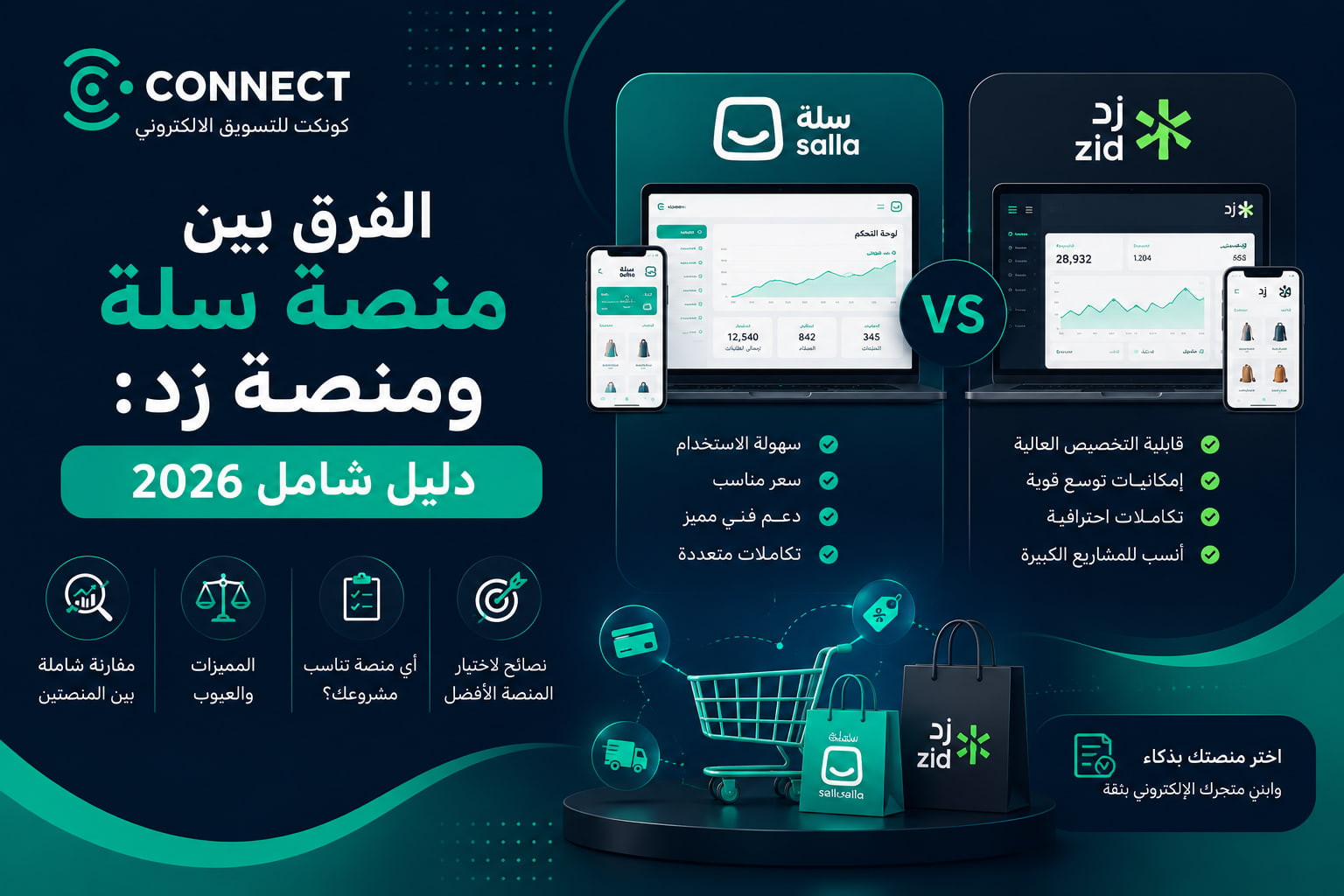
The Difference Between Salla and Zid: A Comprehensive Guide 2026
If you're considering launching an online store in Saudi Arabia, you've undoubtedly researched the differences between Salla and Zid. Both platforms are among the most popular e-commerce solutions in the Saudi market, offering tools that help entrepreneurs easily create and manage their stores without requiring extensive programming expertise.
But the real question is: Which platform is right for your project? Is Salla or Zid better? Or do you need a fully customized online store?
In this comprehensive 2026 guide, we'll compare the two platforms from all angles so you can make the right decision based on your project's needs. Both platforms have undergone continuous updates throughout 2026 in terms of packages, features, and integrations, making this comparison more important than ever.
What is Salla?
Salla is a Saudi platform specializing in creating online stores. It's known for its ease of use and fast store launch, and it offers integration with numerous shipping companies and local payment methods.
Key Features:
User-friendly interface.
Ability to create a store quickly.
Integration with shipping companies.
Support for Saudi payment gateways.
App store to expand features.
What is Zed?
Zed is a Saudi platform specializing in e-commerce, focusing on providing professional solutions for companies and brands that require greater customization and more professional management of their stores.
Its most prominent features include:
Extensive customization options.
Advanced marketing tools.
Detailed reports and analytics.
Support for growth and expansion.
Integration with numerous systems and services.
The difference between Salla and Zed:
1. Ease of use:
If you are a beginner, Salla is characterized by its ease of store creation and quick setup.
Zed offers more customization options, but it may take longer to understand all its capabilities.
2. Design and templates:
Both platforms offer professional templates, but the degree of customization differs.
Salla is suitable for quickly setting up a store.
Zed offers greater flexibility in customizing the design according to the brand identity.
3. Search Engine Optimization (SEO)
When discussing the differences between Salla and Zid platforms, search engine optimization is one of the most important comparison factors.
Both platforms support:
Page title editing.
Meta Description.
Search engine-friendly links.
Google Search Console integration.
Google Analytics integration.
However, the quality of results depends largely on how the store is set up, content is written, and pages are optimized, not just on the platform itself.
4. Applications and Integrations
Both platforms support integration with:
Shipping companies.
Payment gateways.
Inventory management systems.
Marketing tools.
Customer service applications.
The number of applications and integration methods vary between the platforms depending on the available packages and updates.
5. Pricing and Packages
Both Salla and Zid offer multiple packages with varying features and prices.
It is recommended to review the current packages before subscribing, as both platforms regularly update their plans and services.
6. Technical Support
Both platforms offer technical support through multiple channels, with varying levels of support and response times depending on the subscription type and chosen packages.
When to choose Salla?
Salla might be suitable if you:
Are starting your first online store.
Are looking for an easy-to-use platform.
Want to launch your store quickly.
Don't need complex software customizations.
When to choose Zed?
Zed might be suitable if you:
Are an established brand.
Need more customization options.
Want advanced analytics tools.
Are you planning long-term expansion?
Are Salla or Zed suitable for all projects?
While both platforms are powerful, they may not be the best choice in every situation.
If your project requires:
A custom booking system.
A customized control panel.
A subscription system.
A marketplace.
Integration with internal systems.
Development of features that are not currently available.
The best solution might be to develop a custom e-commerce platform or design a custom e-commerce store that meets all your business needs.
Why might you need a custom e-commerce store?
For some projects, a custom store is more flexible because it gives you:
Complete control.
Higher speed.
Scalability.
Unique design.
Better user experience.
Greater SEO flexibility.
How can Connect help you?
If you're confused after learning about the differences between the Salla and Zid platforms, the Connect team can help you choose the right solution, whether it's:
E-commerce store design.
E-commerce store development.
Search engine optimization.
Ad campaign management.
Website design.
Content management.
The company also helps you analyze your project and choose the appropriate platform or build a custom store if that's the best option to achieve your goals.
Frequently Asked Questions (FAQ)
Which is better: Salla or Zid?
There isn't one best platform for everyone. The choice depends on the project size, your budget, and your technical needs.
Can SEO be optimized on Salla and Zid?
Yes, both platforms support search engine optimization (SEO), but results depend on content quality, website structure, speed, and internal and external links.
Do I need a custom store?
If your project requires specific features or significant future expansion, a custom store might be the best option.
Can the store be transferred from one platform to another?
Yes, but the transfer process varies depending on the platform and the data being transferred. Therefore, it's recommended to plan for this before starting the project.
Conclusion: After understanding the differences between Salla and Zid, it's clear that each platform offers advantages suited to a specific type of project. If you're looking for ease of launch, Salla might be suitable. However, if you need more customization and more professional management, Zid might be a good choice. If your project requires specific features or greater flexibility, developing a custom e-commerce store might be the best long-term investment.